Prepare your reading
You are more than your profile: How a reading with depth begins.
A Type can become familiar. A good question opens the conversation. Bring your real life into the reading.
Discover my CODE ↗A first answer
A deep reading begins with an understandable personal question. Describe a specific situation, distinguish knowledge from assumptions and express what you want to clarify. Your profile opens a conversation; your experience, different examples and your decisions remain part of it.
That is just how I am. A small sentence that can close a surprising number of doors. Perhaps your zodiac sign comes before it. Perhaps “Generator”, “Projector” or a profile in which you immediately recognised yourself. Finding words for your experience can be a relief.
A reading becomes especially interesting when an open question appears behind that familiar sentence. What do you actually want to understand? Which encounter stayed with you? A person never fits completely into a brief description. In conversation, your story can become larger than the label.

Bring a scene rather than a finished diagnosis
Suppose you presented an idea to your team. Everyone continued talking without taking up your suggestion. Later, you say: My perspective is never recognised. That sentence already explains a great deal before the scene has even been described.
For the reading, move closer. Who was there? What did you say? What response followed? Was your suggestion rejected, missed or postponed? What had you wanted: a decision, a discussion or support with putting it into practice?
You need not provide a perfect description. Two or three concrete sentences can start the process. They give the conversation something you can look at together. A sweeping claim about yourself becomes a situation with people, conditions and possibilities that remain open.
Familiar words can open a question
The official Jovian FAQs distinguish Type and Strategy from Inner Authority within the Human Design model. [2]
The names “Generator” and “Projector” come from that teaching. Here they are examples of familiar profile words; we do not equate them with cards.
If you say you are a Projector, also ask for this conversation: In which situation would I like my perspective to be heard? If you mention your zodiac sign: Which particular quality do I want to understand? The question makes your starting point understandable to someone else.
A new card term should also open that space. If a description makes you curious, ask about its context. Where does it touch your example? What remains open? A technical term gains meaning through an understandable explanation and an encounter with your experience.
Mention what does not fit the description
Perhaps your suggestion was taken up immediately last week. Perhaps you find it easy to contribute around another person. Bring that scene too. It belongs to you and may show which conditions make a difference.
This does not disrupt a deep reading. It provides material for a more precise conversation. Was the task clearer? Did you know the people better? Did you have more time? As both examples become concrete, a general explanation has less to carry across every area of life.
Personal resonance and scientific evidence are different things. We read the card profile as a symbolic perspective. You may agree with a sentence, adapt it or say: I see this differently in that situation. This freedom keeps your own viewpoint alive in the conversation.
A useful question has an identifiable connection
Before the reading, you can state your wish in one sentence: I want to understand how to present my idea more clearly at the next team meeting. This neither determines the outcome nor asks a profile to predict your future.
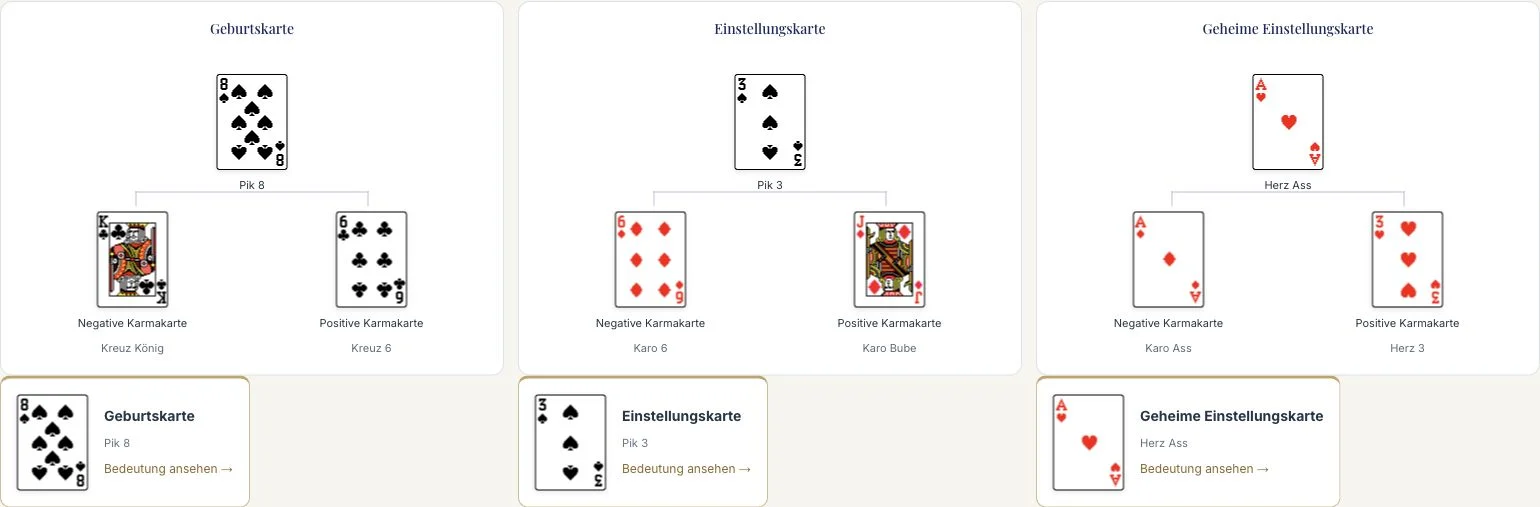
Birth Card, Attitude Card and current Annual Focus offer three personal directions within Schicksalskarten CODE. In conversation, they can help distinguish the fundamental theme, your approach and the question related to your present period. The connection with your example remains central. [1]
You can also say what you expect: an understandable interpretation, a new question or a next step. If you need specialist knowledge or a binding decision in another area, appropriate information belongs in the picture too. A reading cannot replace every form of clarification.
Your own voice should be heard at the end
Perhaps your sentence afterwards is: I want to present my suggestion more briefly and explicitly ask for feedback. Perhaps you realise: I had not understood that I wanted support rather than agreement. Either insight can change a conversation.
Take away a sentence you can formulate yourself. If an interpretation is only understandable in someone else’s technical vocabulary, ask again. Depth can become comprehensible. You do not need to master a system to know which conversation you want to have next.
Your personal CODE can be a beginning. After confirming your email, read the three card perspectives and gather your first question. The CODEX or CODE Coach training can deepen your reading. Your experience remains the living connection that turns a profile into an encounter.
Your questionWhich situation could you describe so that a real conversation can begin?
After confirming your email, discover your Birth Card, Attitude Card and current Annual Focus. Bring a real situation and find the sentence with which your personal reading can begin.
Discover my CODE ↗Questions about this article
Do I need to know my Human Design Type or zodiac sign?
No. You can start with your birth date and a specific situation. Familiar profile terms may provide background; they are not a requirement.
What makes a useful question for a reading?
A question clearly connected to your life, such as: How can I present my idea more clearly at the next team meeting? Describe a particular scene alongside it.
May I disagree with an interpretation?
Yes. Your observations and different examples belong in the conversation. Ask for explanations when a term is unclear and keep the decision about your next steps with you.
Sources & context
The CODE description comes from its own practice. Examples and exercises are editorial suggestions.