Two ways of looking at yourself
Human Design and Destiny Cards: You know your Type. What question remains?
Your BodyGraph is familiar. Now you want to understand a particular life question more clearly. This is where the connection begins.
Discover my CODE ↗A first answer
Human Design and Destiny Cards are different interpretive models. Human Design uses Type, Strategy and Authority. In Schicksalskarten CODE, Birth Card, Attitude Card and Annual Focus open personal themes. You can bring both perspectives to a specific question without equating Types with cards.
You know your Type. Perhaps your Profile, your open Centres and the words that first made you feel: Someone understands me. Yet you sit with a decision and still do not know what you want to say.
This is where things become interesting. Self-knowledge continues beyond recognition. It gains depth when you connect a familiar description with a present encounter. Destiny Cards offer another language for that conversation: structured, visual, with your birth date as the starting point.
Two maps can keep their own legends
Jovian Archive describes the BodyGraph as calculated from birth date, time and place. Type, Strategy and Inner Authority have distinct roles within that model. [2]
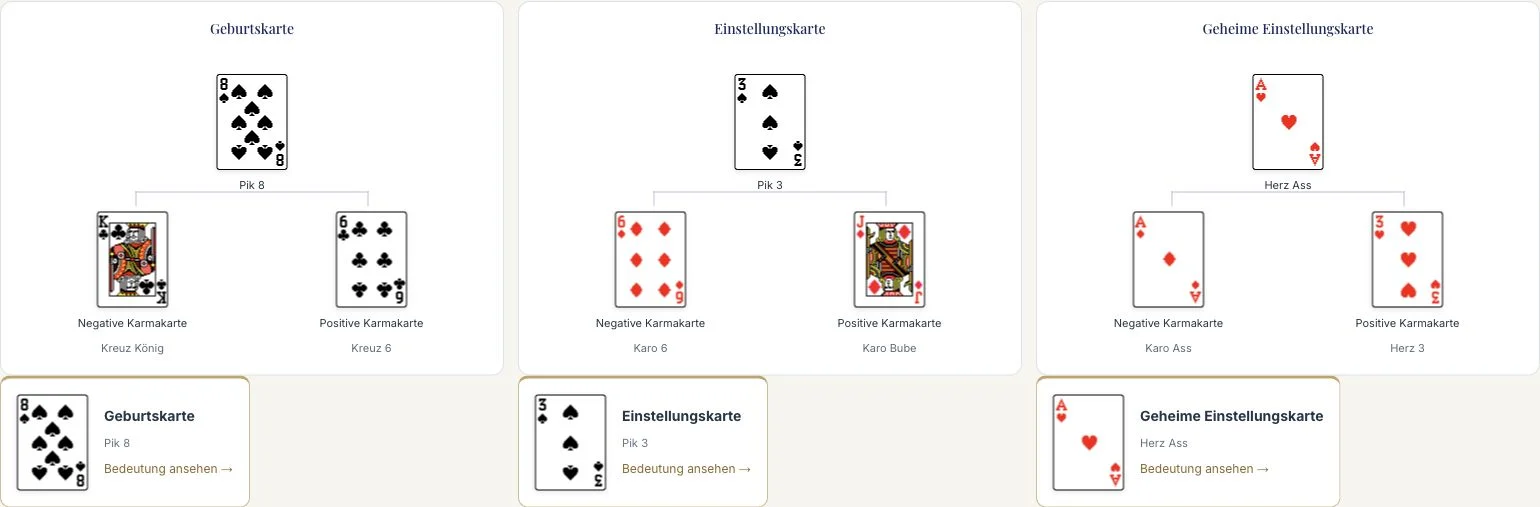
The initial Schicksalskarten CODE offers three different directions: fundamental personal themes through the Birth Card, your approach to situations through the Attitude Card and a perspective on your present period through the current Annual Focus. [1]
A card therefore does not automatically correspond to a Human Design Type. A planetary term is no shortcut for translating one model into the other. The connection happens through your question: Which perspective helps me see something more clearly?
An offer and two familiar responses
Imagine receiving an offer to collaborate. The subject excites you. At the same time, you want to agree immediately because you fear the opportunity might disappear. You read your Human Design profile and recall the decision-making approach described there.
Then you place the three card perspectives alongside it. What fundamental theme does this offer touch? With what attitude do you approach this person? What deserves attention during your current period? The situation becomes more precise when you distinguish its different layers.
Perhaps your real question is not whether the project suits your Type. Perhaps it is: Have I expressed the conditions under which I actually want to take on this work? A useful conversation can start with scope, time and expectations. Your profile finds a place in your life.
Depth grows when differences can remain
When two interpretations sound similar, the connection can feel exciting. Perhaps both mention recognition. This invites further questions. It establishes neither a technical equivalence nor scientific proof that either model measures your personality.
We approach this connection as symbolic self-reflection. Personal resonance can open a valuable question; it is not scientific evidence of effectiveness. You may find an image helpful while examining precisely which observation you connect with it.
Differences can also become productive. One sentence reminds you of patience, another of decisiveness. Where are you waiting attentively? Where are you postponing a necessary conversation? Distinguishing those situations may offer more clarity than finding another umbrella term for your entire life.
Bring your experience into the reading
Prepare a situation in which you face two possibilities. Describe what actually happened, what you want and what you do not yet know. Familiar Human Design terms may come along as background. Keep the conversation question understandable in your own words.
A reading can then relate the card perspectives to this situation. Ask about the context and request an explanation when a term is unclear. Being a good conversation partner does not require agreement or immediate recognition of yourself in a description.
It becomes interesting when you can formulate your own sentence afterwards: With this offer, I want to clarify my available time first. That sentence contains understanding, a boundary and a next step. The decision remains yours.
Your next perspective can already be personal
You do not need another stack of technical terms before beginning. Your birth date opens the first CODE. Read Birth Card, Attitude Card and Annual Focus together, and bring the question that truly holds your attention. One clear sentence can help you formulate your own next step.
The article on the three card perspectives explains their different roles. The article on examining patterns helps you connect resonance with observations. The CODEX and CODE Coach training offer space to deepen your reading and conversational practice.
Perhaps a theme feels familiar. Perhaps a completely new question surprises you. This is what makes the approach worth exploring: You meet your life from another direction and decide for yourself what you want to investigate further.
Your questionWhich particular decision would you like to understand beyond your Type?
Enter your first name, birth date and email. After confirming your email, discover your Birth Card, Attitude Card and current Annual Focus. Bring your most important question into your CODE.
Discover my CODE ↗Questions about this article
Is my Birth Card the same as my Human Design Type?
No. Type and Birth Card belong to different models. You can relate them to the same question, but cannot derive a fixed translation between them.
Do I need my birth time for the Destiny Cards introduction?
For the personal introduction through the three card perspectives, you enter your birth date. The Human Design BodyGraph also uses birth time and birthplace.
Can a profile make my decision for me?
The decision remains yours. A profile can open questions and perspectives; actual conditions, experiences and missing information also belong in your consideration.
Sources & context
The CODE description comes from its own practice. Examples and exercises are editorial suggestions.